DeepSeek's Cheap Model Beats Claude and GPT at Coding
A 552B model that reads your prompt on 8B active parameters and writes the answer on 16B. It undercuts the model above it — and for exactly one day, it was going to replace it.
DeepSeek shipped V4.1 Flash on 10 September 2026.
The pitch was almost too neat: a smaller, cheaper model that beats the flagship on coding and agent work, priced at roughly a third of what V4 Pro costs.
Why the cheap model is cheap
Most models keep one pool of parameters switched on for everything. V4.1 Flash splits the job in two.
DeepSeek calls it a Causal Encoder-Decoder architecture, and it’s asymmetric by design:
- A 20-layer encoder reads your input on roughly 8B active parameters
- A 20-layer decoder writes the reply on roughly 16B
The full model is 552B parameters (mixture-of-experts), but only a sliver is ever awake at once.
Why does “8B to read” matter? Because agent work is input-heavy. When your model is grinding through a long ticket history, a repo, a knowledge base, and forty tool definitions, the overwhelming majority of your tokens are input. V4.1 Flash reads them cheaply and spends its expensive compute on output.
If you’re building anything with a fat prompt and a short answer, that asymmetry is the entire pitch.
The KV cache is the other half
The KV cache — the running memory a model keeps as it works through a context — is normally what makes long-context calls slow and expensive.
DeepSeek squeezed it to 890 bytes per token. For scale:
- about 1/4 the HBM demand of the previous generation
- about 1/8 the SSD footprint
- roughly 437× smaller than DeepSeek’s original V1 cache, which sat at an eye-watering 389,120 bytes per token
That compression is what let DeepSeek raise the parameter count and drop the price. It isn’t a spec-sheet curiosity. In agent workloads a lot of your bill is cache, so a smaller cache is a smaller bill.
What it actually costs
Per million tokens:
- Input, cache hit: $0.003 off-peak / $0.006 peak
- Input, cache miss: $0.15 off-peak / $0.30 peak
- Output: $0.60 off-peak / $1.20 peak
Peak is exactly double off-peak, effective 10 September 2026.
The peak windows are the detail people skip: 01:00–04:00 and 06:00–10:00 UTC, weekdays — Chinese business hours. If you’re running a US or European workload, you’re mostly billing at the cheaper rate without doing anything clever.
It also raises the parameter count on context: 1M tokens in, 384K tokens out, both confirmed on DeepSeek’s own API docs rather than in a press release. A year ago that was a frontier-lab flex. Here it’s the cheap tier.
Where it wins — and where it doesn’t
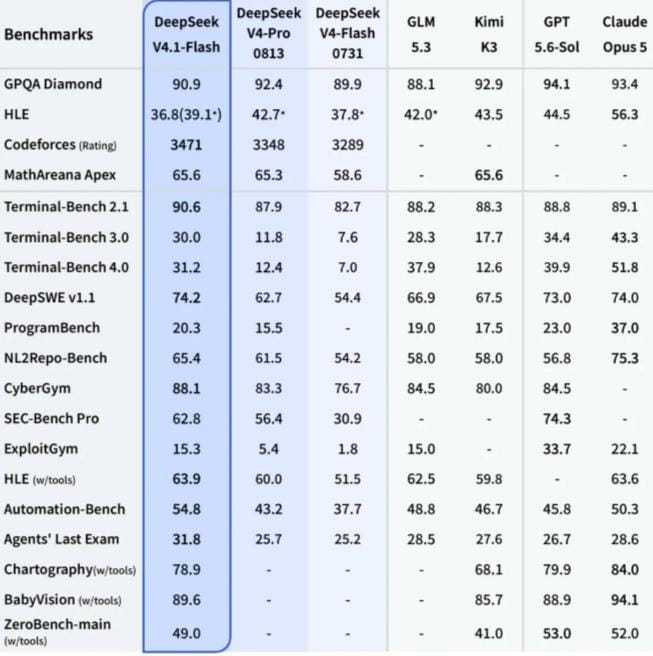
DeepSeek published its own comparison, and these are vendor-run numbers, so read them accordingly:
- Codeforces (rating): 3471 — V4 Pro: 3348
- Terminal-Bench 2.1: 90.6 — V4 Pro: 87.9
- DeepSWE v1.1: 74.2 — V4 Pro: 62.7
- CyberGym: 88.1 — V4 Pro: 83.3
- Automation-Bench: 54.8 — V4 Pro: 43.2
- GPQA Diamond: 90.9 — V4 Pro: 92.4
- HLE, text-only: 39.1 — V4 Pro: 42.7
The pattern is clean, and it’s narrower than “better model.”
V4.1 Flash takes the coding, terminal, security, and automation rows. V4 Pro still leads on GPQA Diamond and text-only Humanity’s Last Exam — raw reasoning, no tools.
So this is a superb tool-using workhorse, not a new reasoning champion. If your work looks like agents, code, and long context, it’s a straight upgrade. If you need it to sit and think through a hard multi-step proof with no tools, it’s a step sideways.
One dial worth knowing about: reasoning effort runs 1 to 100, and it moves results a lot. Going from 25 to 100 lifted DeepSWE from 66.0 to 74.2 and Terminal-Bench from 82.4 to 90.6 — at roughly 2.5× the output tokens. That’s the trade you’re actually making, per request.
The bottom line
V4.1 Flash is the rare release where the newer tier is both cheaper and better than the one below it good enough that DeepSeek briefly planned to retire its own flagship over it.
The architecture is genuinely clever: read cheap, write expensive, compress the memory in between. The benchmarks say tool-use and coding, not abstract reasoning. And the model swap that never happened is the part I’d keep in mind hosted models are dependencies, and dependencies move, sometimes back and forth within a day.
If you’re running high-volume or input-heavy agents, this is worth an afternoon. Point your client at deepseek-flash — it’s OpenAI-compatible, plus Responses and Anthropic API compatible, so for most setups it’s a config change rather than a migration.
Source-based analysis: the numbers here are DeepSeek’s own, from its launch post, technical report, and API documentation. A hands-on run is the next thing this one gets.